

About the author
Once you have completed your project plan, sized the tasks and avoided creating a labyrinthine system with too much detail, you need to move on to the step that will identify the most time critical task sequence. At this point, we recommend that you use the critical chain approach. Unlike the critical path approach, which … Continued
Once you have completed your project plan, sized the tasks and avoided creating a labyrinthine system with too much detail, you need to move on to the step that will identify the most time critical task sequence.
Unlike the critical path approach, which does not consider resources in identifying task criticality, we will search for the longest task sequence considering resource conflicts.
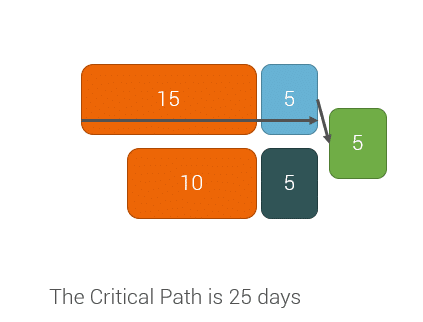
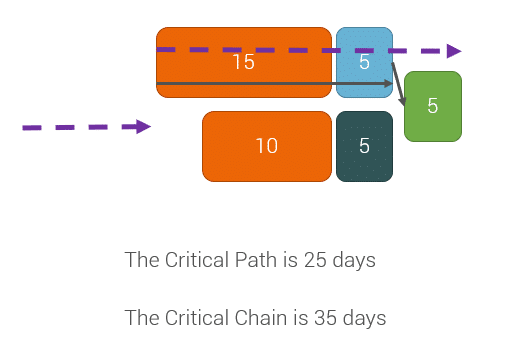
In the example below, we can see that the critical path is 25 days. Whereas if we take into account the resources (in color), the critical chain is actually 35 days! This is because the orange resource (on the left) can only handle one task at a time.
Beyond the consequences of choice, it is important to understand that the critical chain can become a real lever for improving your project.
Indeed, not only does this chain help you focus on the real tasks that make the duration of your project. But it also allows your team to work collectively on improvement actions and/or organization, allowing to reduce the duration of this task.
When the project is underway, a visual marker (a relay) can be used that the team passes around as the project progresses.
The interest of this marker is that it allows to identify who is working on the critical chain tasks and therefore, to leave him alone when he has the relay on his desk.
Yes, but what happens when one person has multiple relays (from multiple projects) on the desk? Does this mean that the critical chain takes into account resources at the project level, but not at the project portfolio level?
Certainly.
So we do need tools to measure the load/capacity of the project portfolio in order to measure the occupancy level of the resources, whether they are working on the critical chain or not?
Certainly.
What if these load/capacity tools only maintain the illusion of being precisely wrong?
More in episode 5.
Topics
About the author
Go further
 Flow Project Management
At this point, everything is going well: But, there are several projects that use the same resources. So, how do you manage this? Most people will tell you that having a project management tool that collects load and capacity will help you drive your choices. This is simply not true. Most load / capacity tools … Continued
 Flow Project Management
You made your project plan (episode 1). Then you verified that it was at the right level of detail (episode 2)... knowing that there is an uncertainty that you will discover. How will/should you incorporate these elements into the project plan update? Whoa, slow down! We are going to integrate EVERYTHING into the schedule, aren't … Continued
 Flow Project Management
In the previous article, we saw what a project plan was and the elements to start building it. We ended with the following question: When did I reach the right granularity? How can I manage a project over several years? It is to these questions that we will try to answer in this article. The … Continued
Does this article resonate?
Our consultants help you translate these reflections to your Supply Chain and your teams — diagnosis, scoping or operational delivery.