

About the author
In the previous article, we saw what a project plan was and the elements to start building it. We ended with the following question: When did I reach the right granularity? How can I manage a project over several years? It is to these questions that we will try to answer in this article. The … Continued
In the previous article, we saw what a project plan was and the elements to start building it. We ended with the following question:
It is to these questions that we will try to answer in this article.
The classic answers are:
Generally speaking, both of these statements are good and relevant. However, let's try to specify concretely how to proceed.
In our experience, we have seen that this first element allows us to identify anomalies in the project. However, there is no question of having a binary view on the treatment of this range.
We encourage you to identify the tasks around these "anomalies" to see if a grouping is possible. In fact, if you go into too much detail in your project plan, you often end up with a series of tasks lasting x days for the same resource. Thus, it could be judicious to group these tasks, carried out by the same functions, into a single task, while reclarifying the input data and deliverables.
Concerning the frequency of monitoring your schedule; what are the benefits of detailing two-day tasks (or even half-day tasks, yes, I swear) when the schedule is updated every week… and the project lasts 2 years?
By applying the 3-10% "rule", you will be able to simplify your project in a controlled manner while making it easily manageable (granularity).
Here is an example of what we try to avoid in terms of project plan visibility:
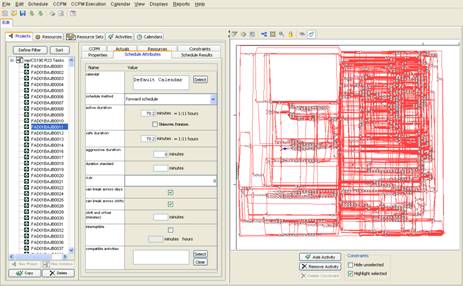
No need to specify that the management of this project will be somewhat complicated and may frustrate quite a few people… (especially the one who will update the links ). Yet the project lasts several years and this complexity is real!
The classic way is to try to split the project into sub-projects, within a limit of 150 tasks. Here are some additional tips to help you with this breakdown:
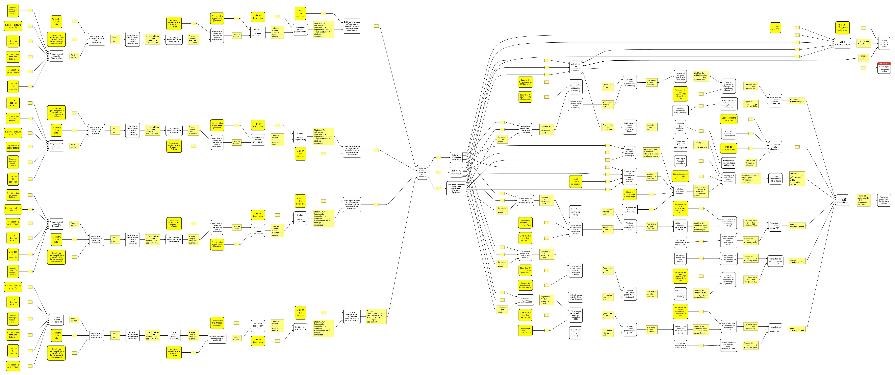
VoYou have a CAPEX project that will go through a budgeting/requirements phase/search and validation of the supplier. Then a procurement phase with the selected supplier, and finally the installation on site. Wanting to detail the plan too far upstream limits your flexibility when you move to execution. You may want to have one project that goes all the way through to placing orders with suppliers. Then another project that includes both procurement and installation.
Keep in mind that no matter how detailed you get, you will never have a project plan that is 100% right. Therefore, applying these principles is a way to simplify your life while accepting a certain level of uncertainty.
So the next question is:
More in episode 3…
About the author
Go further
 Flow Project Management
At this point, everything is going well: But, there are several projects that use the same resources. So, how do you manage this? Most people will tell you that having a project management tool that collects load and capacity will help you drive your choices. This is simply not true. Most load / capacity tools … Continued
 Flow Project Management
Once you have completed your project plan, sized the tasks and avoided creating a labyrinthine system with too much detail, you need to move on to the step that will identify the most time critical task sequence. At this point, we recommend that you use the critical chain approach. Unlike the critical path approach, which … Continued
 Flow Project Management
You made your project plan (episode 1). Then you verified that it was at the right level of detail (episode 2)... knowing that there is an uncertainty that you will discover. How will/should you incorporate these elements into the project plan update? Whoa, slow down! We are going to integrate EVERYTHING into the schedule, aren't … Continued
Does this article resonate?
Our consultants help you translate these reflections to your Supply Chain and your teams — diagnosis, scoping or operational delivery.