

About the author
In the first season, you discovered the different ways to analyze a Fever Chart. It's time to start season 2, which will focus on the use of a project plan. In this article, we will describe: In the following articles, we will clarify: - how to split a project, - to which level of granulometry … Continued
In this article, we will describe:
In the following articles, we will clarify:
- how to split a project,
- to which level of granulometry it is necessary to go,
- how to reduce the duration of a project
- and finally, the eternal debate about the resources load and capacity in project management tools.
If you don't always agree on what it actually means when your project is done. Or if you are missing inputs to start some tasks, while the upstream teams are sure that they have completed their work properly… Then your project plan is flawed!
Where the WBS (Work Breakdown Structure) strives to clarify the nomenclature of the project, the project plan (Network Diagram) seeks to establish the range and therefore the relationship between the tasks.
To use an analogy found on the web, it is the story of the philosophy teacher who fills a jar with pebbles in front of his students. When the jar is full of large stones, he asks his audience if the jar is full. The students confirm. Then the teacher takes some gravel and comes to fill the jar with it. And so on.
At the highest point, we will identify the name of the project as well as the necessary deliverables and input data. For this, two questions will guide us:
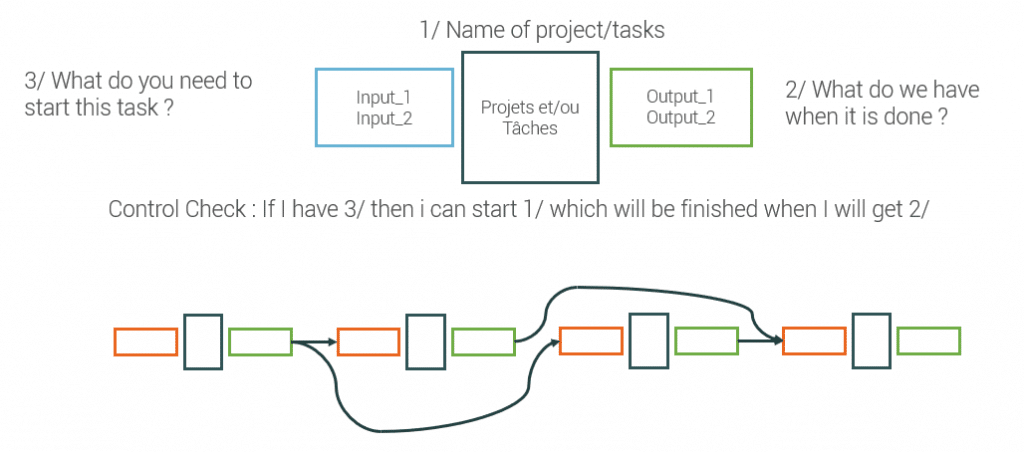
When this step is completed, we will look to identify the major steps of this project (not necessarily milestones). The question we often ask our clients is:
For each of the ideas identified, we will ask the first two questions, to clarify the deliverables and inputs needed to complete these steps.
Next, we will:
When this process is done, the creation of links may reveal several cases:
When you're done, you'll get something that looks like this:
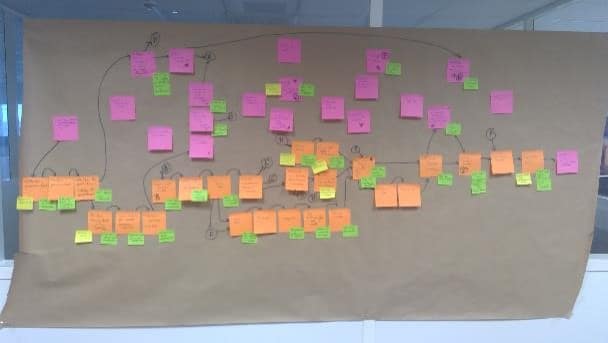
At the end of this process, you will be able to identify the skills needed for each task and the associated estimated duration. This is not to get into a debate about task estimation, but if you are familiar with our approach, you know that it is better to enter safe durations in order to exploit these margins in a different way.
You may have noticed that this process is iterative. The corollary is at what point should I stop iterating? When my projects are very long, how do I manage a multi-year project? And so on…
More in episode 2...
Ps : Below is a link that details the whole process. It was written by Mrs Austin and is, in my opinion, the best description of what a Network Diagram is.
Topics
About the author
Go further
 Flow Project Management
At this point, everything is going well: But, there are several projects that use the same resources. So, how do you manage this? Most people will tell you that having a project management tool that collects load and capacity will help you drive your choices. This is simply not true. Most load / capacity tools … Continued
 Flow Project Management
Once you have completed your project plan, sized the tasks and avoided creating a labyrinthine system with too much detail, you need to move on to the step that will identify the most time critical task sequence. At this point, we recommend that you use the critical chain approach. Unlike the critical path approach, which … Continued
 Flow Project Management
You made your project plan (episode 1). Then you verified that it was at the right level of detail (episode 2)... knowing that there is an uncertainty that you will discover. How will/should you incorporate these elements into the project plan update? Whoa, slow down! We are going to integrate EVERYTHING into the schedule, aren't … Continued
Does this article resonate?
Our consultants help you translate these reflections to your Supply Chain and your teams — diagnosis, scoping or operational delivery.